

Publishing Your Evidence: Strategy for Healthcare Companies
A practical guide to evidence strategy for healthcare companies
Do you actually need to publish a peer-reviewed paper?
If you work in digital health and you're sitting on data you've been meaning to publish, you're not alone. There's often a gap between knowing you should be doing something with your data and knowing what that something actually is.
At a recent Sci-translate community session, Dr Valerie Hoffman, founder and CEO of Pogo Research, psychiatric epidemiologist, and fractional research executive for digital health startups gave us a practical, no-nonsense framework for thinking it through.
With over 100 peer-reviewed publications, federally funded research across NIH, SAMHSA, AHRQ, and CDC, and senior science roles at Woebot Health and Meru Health behind her, Valerie has seen publishing from every angle: as an author, as a peer reviewer, and as the person companies call when they're not sure what they're doing.
Academic publishing vs white papers: which is right for your healthcare company?
The most important reframe of the session was that peer-reviewed journals are not the gold standard that everything else aspires to. They are one option among many, and not always the right one. White papers, industry reports, case studies, internal decks and data summaries all have genuine roles to play in an evidence strategy, and in many business contexts they will serve you better than a journal article ever could.
"This isn't a hierarchy where journals are always better. It's a menu. The right choice depends on your audience and your timeline."
Think of it this way, the same data can be the basis for a Michelin-starred tasting menu or a really good sandwich. Both require quality ingredients. The question is who's coming to dinner.
When does a peer-reviewed publication actually make business sense?
There are situations where a peer-reviewed publication is clearly the right call. If you need to build credibility for a payer contract, a regulatory submission, or an institutional partnership, nothing signals scientific rigour quite like peer review. If you're pursuing federal funding, publications directly support NIH and SBIR applications, a publication record isn't just nice to have, it's load-bearing. If you're playing a long game, building a citation base over time turns your research into a compounding asset. And if you're trying to attract clinical or research talent, publishing signals that your organisation takes science seriously.
When to skip the journal
But there are just as many situations where the journal is the wrong tool. If you're in a sales cycle or a fundraising round, you cannot wait twelve months for a paper to land.
“A white paper you can publish next month beats a journal article you'll see in a year or two. If your audience is investors, employers, or payers, the format matters as much as the content.”
These audiences read decks and one-pagers, not methods sections. If your data is early-stage, a well-framed internal analysis or a case study developed with a partner is often the more honest and more strategic choice. And if you need to control your narrative, peer review constrains your framing in ways that can work against a business-oriented message.
How to measure the ROI of publishing in healthcare
A useful framework for cutting through this decision is the distinction between:
- ROI: return on investment
- VOI: value on investment
ROI is transactional: what does this evidence cost vs earn?
VOI is longer-range: what does this evidence enable over time, even indirectly like credibility, talent attraction, the next partnership you can't yet see?
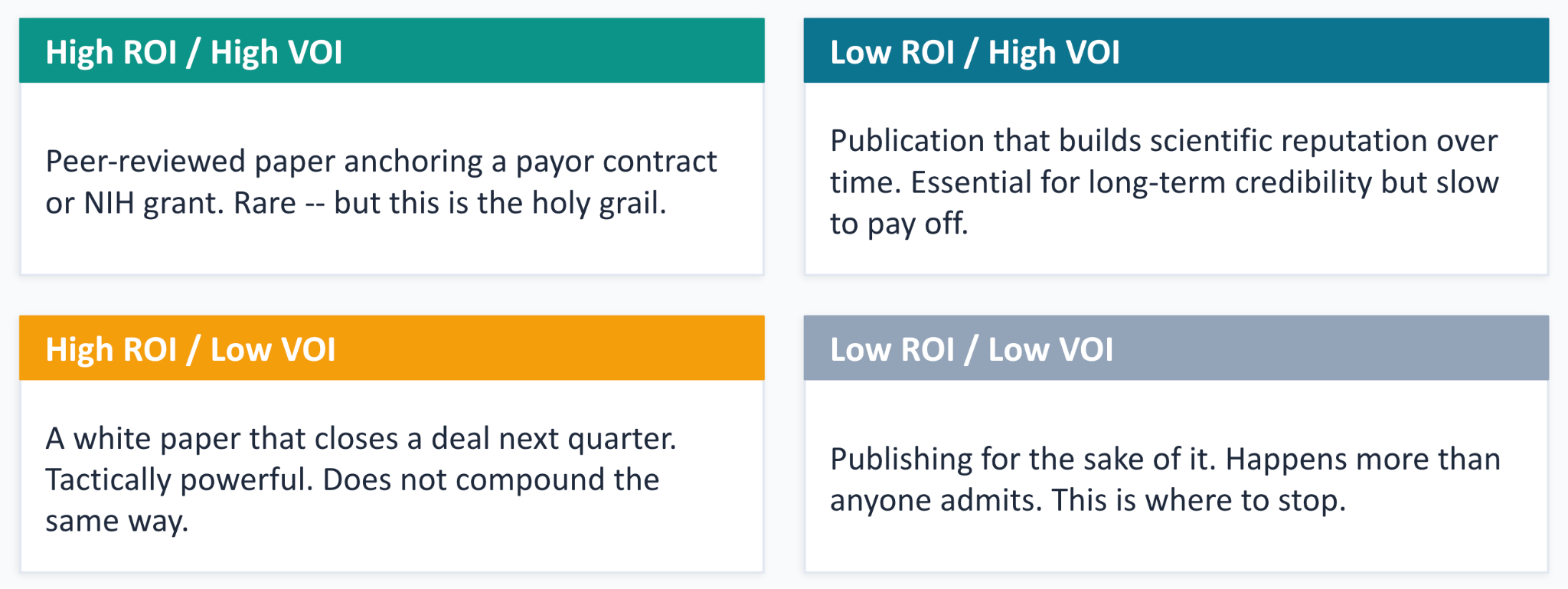
The sweet spot is high ROI and high VOI: a peer-reviewed paper that directly anchors a payer contract or an NIH grant. This exists, but it's rare.
"A paper that enables a two-million-dollar payer contract is worth the twelve-month investment. One that doesn't move any needle is not."
A white paper that closes a deal next quarter is high ROI, lower VOI, it’s worth doing, as long as you don't confuse it with a scientific contribution. A reputation-building paper in a strong journal might be low ROI in the short term but high VOI over years and worth it if you're confident you're playing a long game, but a gamble for early-stage startups who can't be certain of that.
And then there's what Valerie called the graveyard of low ROI and low VOI:
"Publishing for the sake of publishing. A paper no one cites, that doesn't help any deals or any grant, just costs six to twelve months and a lot of money."
And it happens more than anyone admits.
How to turn your existing health data into a publication strategy
A consistent theme across the session was how often companies underestimate the publishable material they already have. The bottleneck is almost never the data, it's the strategy. Companies collect data for operational or product purposes, look at it through that lens, and never ask what else might be in there.
Most companies have more publishable data than they think
So how do you turn your data into evidence?
- Audit what you have: what outcomes data, engagement data, assessments, trial results, or claims data do you actually have?
- Define your audience: who are you selling to, and what do they need to see?
- Match format to goal: publications for credibility, white papers for sales, decks for boards, abstracts for conferences.
- Start with what is ready: secondary analyses of existing data are often faster and lower risk than designing new studies, and there are almost always two or three publishable questions buried in a dataset that was collected for an entirely different purpose.
Don't just publish your most obvious finding
This also means thinking carefully about what's actually interesting. One company Valerie worked, Grow Research, with arrived wanting to publish standard outcomes data. When pushed on what made the platform distinctive, it turned out that users' choices about provider identity and specialty were associated with differential patterns in engagement and outcomes. That became the paper and it proved far more useful than the straightforward outcomes paper the company had originally envisaged.
Read the paper here: JMIR Formative Research - Patient-Provider Matching, Engagement, and Outcomes of a Digital Mental Health Treatment Platform: Real-World Retrospective Cohort Study
"Having publications is not the same as having a publication strategy."
Using AI to write research papers: what the journals actually say
No conversation about publishing in 2026 can sidestep AI, and this one didn't. Major journals including Nature, JAMA, and the Lancet now have explicit policies against manuscripts substantially written by AI, and peer reviewers are increasingly trained to spot it. Submitting AI-generated content to a journal that prohibits is risky and technically it's a form of research misconduct, with potential consequences including retraction and lasting reputational damage.
The distinction that matters is between AI writing your paper and AI supporting your process. Using AI to organise ideas, sense-check logic, or draft an outline you then substantially rewrite is a different thing from submitting chatbot-generated text as your own scientific work. The test is simple:
"If you could not defend every methodological decision, every analytical choice, and every interpretive claim to a room full of peer reviewers, it's not ready to submit. The intellectual substance has to be genuinely yours."
If the journal's AI policy is ambiguous, email the editorial office before you submit. They will reply, and it's a much easier conversation than the one that follows a rejection on those grounds.
Building a publication strategy for your healthcare startup: where to start
If you're sitting on data and not sure what to do with it, the practical takeaway is this: before you commission a new study or start drafting a manuscript, ask what you already have and what you actually need. A clear publishing strategy (even a rough one) is a competitive advantage in itself. Most healthcare companies don't have one.
"A clear publishing strategy is in itself a competitive advantage. Most digital health startups don't have one, so if you start with a rough framework for yours, that's a win."
For help with your publishing strategy, please contact Dr Valerie Hoffman, founder and CEO of Pogo Research.
Interested in joining the Sci-translate community?
The best part of sessions are the conversation that follow. We host a free, online community for scientists, clinicians, creatives and industry professionals working in healthcare come to think out loud, ask the questions they can't ask elsewhere, and connect with people who understand the space.
Join us to access sessions, recordings, and a network that understands the work you do. Learn more about the community and sign up here.

.svg)